By Sanjeev KUMAR
Abstract
This paper analyses the competitive dynamics of the Indian retail brokerage industry, focusing on the structural market dominance of Zerodha and evaluating a theoretical disruption model led by an AI-native global challenger, such as Revolut. Since 2010, Zerodha has maintained its position through capital-heavy clearing moats, zero-marketing customer acquisition, and highly optimized, flat-fee operational infrastructure. However, the emergence of unified, AI-driven Straight-Through Processing (STP), multi-license corporate architectures, and algorithmic liquidity provision presents a new vulnerability for incumbents. This study examines how a heavily capitalised, global financial technology firm utilising a unified artificial intelligence core could leverage capital subvention, structural cross-border rails, and exchange-approved proprietary market-making mechanisms to bypass traditional retail limitations. By pivoting from consumer-fee monetization to systemic institutional liquidity capture, such an entity offers an alternative paradigm for the future of digital asset management and market infrastructure.
I. Introduction: The Anatomy of an Incumbent’s Dominance
The Indian retail brokerage landscape underwent a fundamental regime shift post-2010 with the introduction of the discount brokerage model. Zerodha pioneered this transition by replacing traditional, percentage-based transaction commissions with a flat-fee architecture (₹20 per derivative/intraday order) and offering zero-cost equity delivery. By eliminating traditional brick-and-mortar overhead and relationship management workforces, the firm achieved operating margins approaching 60%.
The resulting economic moat is not merely architectural but capital-centric. Stock brokerage operations are fundamentally trust and liquidity businesses. The National Securities Clearing Corporation Limited (NSCCL) requires clearing members to deposit substantial daily cash collateral to back aggregate retail exposure. Zerodha’s bootstrap capital structure, multi-thousand-crore cash runway, and organic word-of-mouth client acquisition have effectively insulated it from VC-backed customer acquisition cost (CAC) wars.
II. The Structural Bottlenecks of Capital Markets
A common critique of incumbent brokers is that their technological infrastructure can be easily replicated using contemporary artificial intelligence frameworks. While AI-driven Straight-Through Processing (STP) can optimize data-routing, ledger reconciliation, and template-based compliance reporting, it encounters three hard, non-software limitations:
- The Physical Latency Limit: High-frequency execution requires co-location infrastructure within the physical premises of the exchange (NSE/BSE). Algorithmic data packets are bound by the physics of fiber-optic transit, meaning external cloud-hosted AI engines face immutable latency penalties.
- The Regulatory Accountability Mandate: Securities and Exchange Board of India (SEBI)frameworks dictate that algorithmic and automated trading models operate under strict accountability rules. Technology cannot dilute legal liability; systems must feature manual kill-switches, deterministic parameters, and explainable models to mitigate systemic risk.
- The Capital Cleardown Requirement: Increased transaction volume, even if processed flawlessly via automated STP, accelerates the peak margin requirements imposed by the clearing house. Scalability is therefore a function of treasury depth rather than algorithmic efficiency.
III. The Corporate Workaround: The Multi-License Stack
To bypass the regulatory “Chinese Walls” separating pure banking or lending institutions (regulated by the Reserve Bank of India) from equity trading infrastructure (regulated by SEBI), a modern market entrant must deploy a sophisticated corporate structure. This framework is successfully demonstrated by specialized institutional firms that maintain ring-fenced, multi-license stacks combining Non-Banking Financial Company (NBFC) capabilities, Category-I Merchant Banking licenses, and Stock Broker memberships.
When scaled to the retail market, this architecture allows a parent holding company to spin off a pure digital broker while utilizing its sister NBFC to handle real-time margin funding and capital underwriting at arm’s-length market rates. This arrangement effectively neutralizes the legal liability barrier: the counterparty to the regulator is not an amorphous AI agent, but a fully capitalized, licensed corporate entity.
IV. The Revolut Disruption Matrix: A Strategic Playbook
If a global financial entity with the scale of Revolut were to orchestrate a focused market entry into India’s capital markets, its theoretical path to dismantling the incumbent’s dominance relies on three distinct retail axes:
A. Capital Subvention and Predatory Pricing
While domestic startups face high capital costs, a global player with a multi-billion-dollar balance sheet can treat the Indian retail market as a loss-leader. By absorbing the clearing corporation’s margin costs at the holding-company level, the attacker could introduce a 100% free trading model (₹0 flat fee across intraday and options trading). This directly compromises the core revenue generation mechanism of the discount brokerage model.
B. Algorithmic Asset Consolidation via a Unified AI Core
Unlike incumbents that offer segregated application ecosystems for trading, mutual funds, and reporting, a native platform can employ a unified, multi-modal artificial intelligence model (analogous to global systems like PRAGMA). By processing real-time spending data, domestic UPI transaction flows, and investment portfolios simultaneously, the platform can automate wealth management. The AI acts as an autonomous co-pilot, conducting behavioral risk assessments and executing systematic asset allocation without requiring the user to navigate standalone trading environments.
C. Cross-Border Arbitrage and Asset Capture
The modern affluent Indian demographic exhibits a growing demand for geographic asset diversification. Leveraging existing Authorised Dealer Category-II (AD-II) forex rails and global custody infrastructure, a global challenger can offer frictionless, fractional access to international equities under the Liberalised Remittance Scheme (LRS). By positioning itself as the exclusive gateway for cross-border wealth management, the platform can capture high-net-worth retail volume before routing those users into domestic equity and derivative products.
V. Shifting the Paradigm: Monetization via Liquidity Architecture and Institutional Market Making
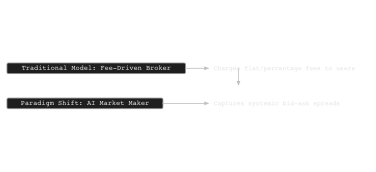
The ultimate evolution of this technological assault lies in moving entirely away from consumer-derived stock trading revenue. Instead of operating purely as an intermediary broker fighting a low-margin retail customer acquisition war, a global entity can weaponize its AI-first engine to become a dominant electronic liquidity provider and market maker.
A. Foreign Exchange Market Making via Closed-Loop Routing
Operating under an AD-II and Prepaid Payment Instrument (PPI) licensing stack, the challenger avoids passing cross-border or forex data to external legacy banking clearinghouses. Instead, a unified global engine acts as the internal counterparty. By utilizing deep learning models to predict inventory imbalances, the system matches inward remittances with outward multi-currency expenditures across a global network. By functioning as the principal liquidity provider, the platform captures the underlying bid-ask spread dynamically, extracting high-margin revenue from raw transactional volume while advertising a “zero-fee” interface to the end-consumer.
B. Navigating the Regulatory Firewall on Domestic Equities
Porting a market-making model to Indian equities requires bypassing SEBI’s strict prohibition on Payment for Order Flow (PFOF). Because Indian regulatory frameworks mandate that all retail client transactions settle directly inside the exchange’s central limit order book, a broker cannot internalize equity flows or sell order data to third parties.
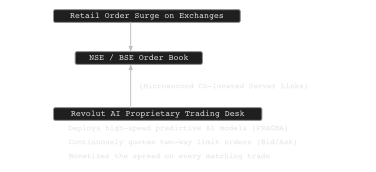
To extract monetization without reliance on standard stock trading commissions, the challenger must step onto the exchange floor as an exchange-approved, institutional proprietary market maker.
C. Algorithmic Inventory Management and Maker Rebates
Using co-located servers and dedicated, low-latency infrastructure, the firm’s algorithmic trading desks can continuously quote two-way limit orders across highly liquid equity derivatives and options chains.
- Risk Management via Neural Nets: Instead of relying on rigid, hard-coded execution models, an advanced machine learning architecture can forecast short-term volatility regimes. This enables the desk to safely compress its bid-ask spreads without taking toxic inventory directional risk during market crashes.
- Treasury Leveraging: The global balance sheet solves the clearing corporation capital bottleneck. The firm can seamlessly position hundreds of crores in cash collateral directly within exchange clearing rings to support massive, continuous market depth.
- Exchange Incentive Harvesting: By consistently providing resting liquidity, the institutional desk captures structural volume-based transaction fee discounts and exchange maker rebates directly from the utility houses (NSE/BSE). The platform becomes entirely uncoupled from retail user acquisition, profiting consistently from the macroeconomic velocity of the entire capital ecosystem.
VI. Comparative Analysis: Structural Resistance Factor
| Strategic Vector | Zerodha Moat Structure | Revolut Attack Vector |
|---|---|---|
| Monetization Architecture | High-volume flat-fee retail dependency | Cross-subsidized ecosystem and institutional spread capture |
| Core Product Positioning | Utilitarian capital markets engine | All-in-one lifestyle wealth and global liquidity hub |
| Data Utilization | Isolated domestic client ledger | Global multi-asset transactional data loop |
| Market Infrastructure Link | Downstream retail broker routing | Direct, co-located institutional liquidity provision |
VII. Conclusion
The thesis that the retail brokerage industry is structurally insulated from further disruption due to regulatory barriers or incumbent scale assumes a static technological environment. While traditional automated systems cannot break the physical constraints of the exchange plumbing, a heavily capitalized global financial institution using an integrated multi-license corporate structure can render those constraints irrelevant through financial subvention.
By pivoting the primary monetisation architecture from client transaction commissions to automated cross-border and institutional market making, an AI-native challenger detaches itself from the constraints of a traditional broker. Ultimately, this structural shift serves as a micro-level case study of the broader “AI-zation” phenomenon occurring globally.
As machine intelligence transitions from a mere software optimisation tool into a foundational economic utility, it fundamentally alters the capital moats of private corporations and the productive capacities of nations alike. By harvesting the underlying bid-ask spread of the broader market, a global super-app possesses the structural architecture required to shift the financial paradigm, proving that in the age of productive intelligence, entrenched monopolies can be challenged at the infrastructure level.
In an open centralized order book, speed is a function of physics, but scale is a function of treasury depth. By decoupling execution from retail fees and weaponizing the systemic bid-ask spread, an AI-native infrastructure play transforms a trading app into a sovereign asset class. Entrenched monopolies do not fall to better code—they dissolve when a global balance sheet transforms their entire market into its private liquidity loop.


Leave a Reply