By Sanjeev Kumar Founder & Architect, HOLNESS Ecosystem
Prologue: A Two‑Hour Conversation That Revealed the Truth About HealthTech Investing
A few days ago, I spent two hours speaking with a close friend — someone who runs a venture capital fund and has been investing in healthTech for years. He was frustrated. Many of his bets hadn’t worked out. The promises hadn’t materialised. The hype hadn’t translated into outcomes.
He said something honest:
“There’s too much hype in healthTech and not enough reality.”
He’s right. But he’s also part of the problem.
Because hype doesn’t exist on its own. Hype exists because investors fund it.
And during that conversation, it became clear that while he was disappointed with the companies he backed, he had never fully interrogated what exactly he was funding.
He funded:
- fragments
- dashboards
- wearables
- biomarkers
- supplements
- apps
- protocols
- “AI‑powered” promises
But he never funded ecosystems. He never funded continuity. He never funded integration. He never funded the sum of everything that makes a human healthy.
He funded hype because hype was easy to understand. He avoided reality because reality was complex.
That conversation became the spark for this article — because it revealed a deeper truth:
Investors are not just victims of hype. Investors are co‑authors of hype. And they must take responsibility for funding fragmentation instead of health.
This article is the result of that conversation — a clear, evidence‑backed explanation of why healthTech investing has failed for 20 years, why longevity hype has produced almost no real gains, why wearables remain unprofitable, why celebrity doctors distort science, and why only an ecosystem approach can fix what is broken.
1. The uncomfortable truth: Healthcare investing has failed humanity
For two decades, investors have poured tens of billions into digital health, longevity biotech, wearables, wellness apps, and “AI‑powered” health tools.
Yet global health outcomes have barely moved.
- Chronic disease continues to rise
- Mental health continues to deteriorate
- Life expectancy has stagnated or declined in many regions
- Longevity breakthroughs remain theoretical
- Wearables have not produced population‑level improvements
- Digital health has not reduced the burden on health systems
This is not a coincidence. It is a structural failure in how investors allocate capital.
2. The maths over 20 years: enormous capital, negligible outcomes
Digital health + longevity investment (global, 20 years):
Across OECD, UK, US, and Asia, estimates show $60–80 billion invested into:
- digital health platforms
- wearables
- longevity biotech
- anti‑aging clinics
- wellness apps
- biomarkers
- supplements
- AI‑health tools
Failure and stagnation rates:
- UK healthtech: £27.4B raised, yet dozens of failures and distressed exits.
- Global early‑stage healthtech failure rates exceed 70–80%.
- Longevity biotech: fewer than 5% reach late‑stage trials; almost none deliver validated lifespan extension.
- Wearables: majority remain unprofitable, with high churn and negligible clinical impact.
Health outcomes:
Despite all this capital:
- chronic disease costs exceed $400B annually
- metabolic disorders are rising
- mental health burden is rising
- life expectancy has not meaningfully increased
- no validated intervention has extended human lifespan at scale
The maths is unforgiving:
Tens of billions invested. Almost no structural improvement in human health.
3. Why investors fail: they fund fragments, not ecosystems
The core reason investors fail is simple:
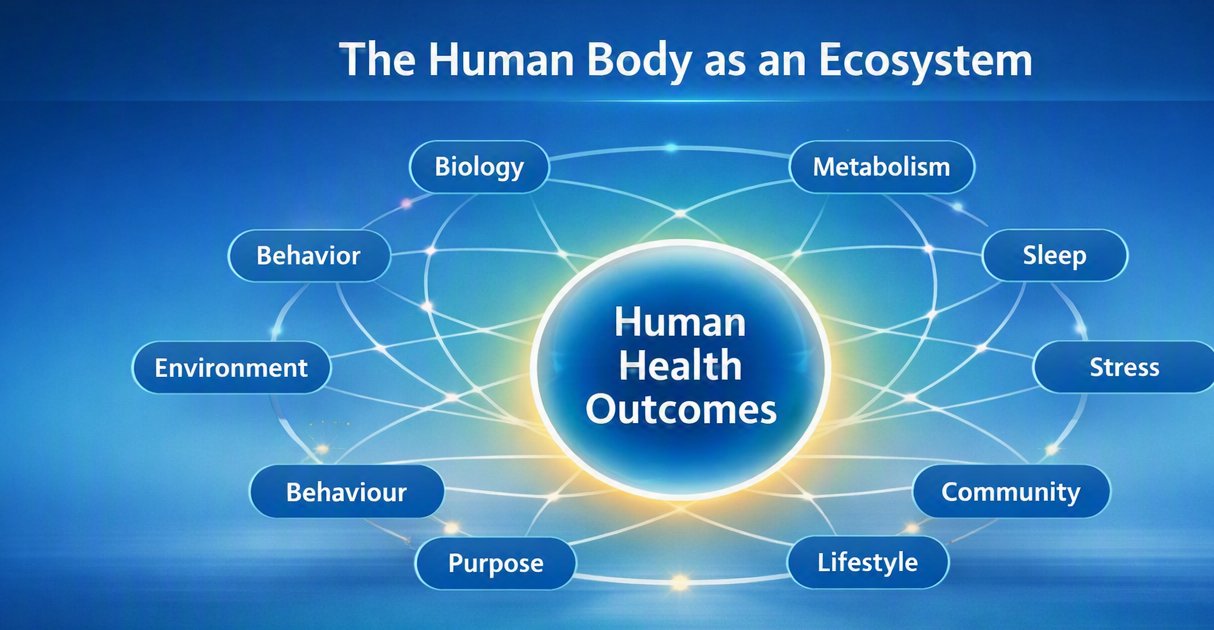
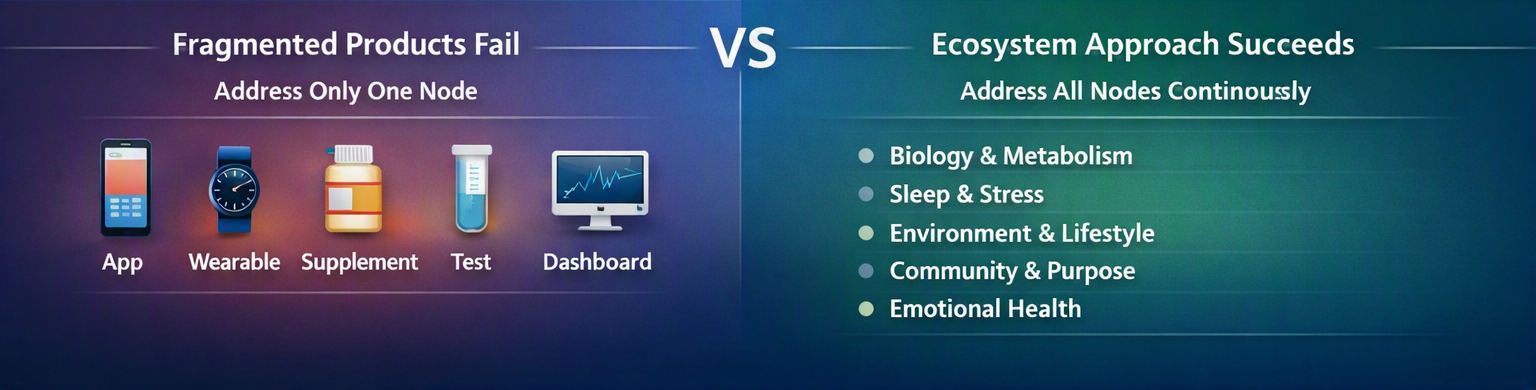
Investors fund fragments. Human health is an ecosystem.
Investors fund:
- apps
- wearables
- biomarkers
- supplements
- clinics
- dashboards
- protocols
- pills
But human health is:
- biological
- behavioural
- environmental
- metabolic
- psychological
- social
- cultural
- economic
Health is everything, everywhere, all at once.
Fragmented products cannot solve ecosystem problems.
4. The science is clear: ageing and chronic disease are multi‑system phenomena
Ageing is not caused by one pathway. Chronic disease is not caused by one behaviour. Mental health is not caused by one neurotransmitter.
Science shows that health outcomes emerge from interconnected systems:
- mitochondrial function
- metabolic stability
- inflammation
- sleep
- nutrition
- movement
- stress
- pollution
- relationships
- purpose
- environment
This is why:
A magic pill cannot fix ageing. A wearable cannot fix metabolic disease. An app cannot fix mental health.
Yet investors continue funding single‑system interventions for multi‑system problems.
This is the structural misalignment.
5. Evidence: continuity and integration outperform fragmentation
Continuity of care reduces mortality and improves outcomes
A major UK review of 180 studies found that continuity of care — seeing the same clinician over time — is consistently associated with lower mortality, better morbidity outcomes, and improved patient experience.
Integrated care models dramatically outperform siloed care
Across 12 sites in six countries, integrated care for chronic disease delivered:
- 38.4% reduction in 30‑day readmissions
- 45.5% reduction in preventable emergency visits
- 31.6% reduction in annual per‑patient costs
- 28.5% improvement in quality of life
Digital health only works when embedded in ecosystems
European reviews show digital tools succeed only when integrated into multidisciplinary care pathways, not when deployed as standalone apps or devices.
The science is unambiguous: continuity and integration work. Fragmentation does not.
6. Longevity investing: a 20‑year hype cycle with almost no real gains
Longevity is the most dramatic example of investor failure.
For two decades, longevity startups have promised:
- biological age reversal
- 200‑year lifespans
- cellular rejuvenation
- miracle supplements
- gene editing breakthroughs
- AI‑driven anti‑aging
But the outcomes are:
- no validated lifespan extension
- no population‑level healthspan improvement
- no scalable rejuvenation therapies
- no reduction in chronic disease
- no clinically proven anti‑aging pill
Investors have lost extraordinary amounts of money because longevity has been treated as a trend, not a science.
Companies exaggerate claims because the VC model demands hype.
The result:
Longevity has become a theatre of claims rather than a field of outcomes.
7. Wearables: too many devices, too little profit, zero meaningful impact
Wearables are another capital sinkhole.
Despite billions invested:
- most wearables are unprofitable
- retention is low
- subscription conversion is low
- churn is high
- differentiation is minimal
- clinical impact is negligible
Wearables generate data, not health.
Data without continuity becomes noise.
Wearables are fragments pretending to be solutions.
8. Social‑media doctors: visibility over science
Instagram and LinkedIn have created a new class of “celebrity doctors” who optimise for:
- virality
- aesthetics
- personal branding
- supplement endorsements
- biohacking theatrics
This reinforces the same fragmentation investors create.
Visibility becomes mistaken for credibility. Content replaces care. Performance replaces science.
This distorts public understanding and investor behaviour.
9. Prevention Is Not a Magic Pill — It Is an Ecosystem
One of the biggest misconceptions in modern health is the belief that “prevention” can be achieved through:
- constant testing
- endless diagnostics
- supplements
- biohacking gadgets
- longevity pills
- wearables
- protocols
- dashboards
This is not prevention. This is monitoring.
Monitoring tells you what is happening. Prevention changes what will happen.
And the science is clear:
Prevention is not a product. Prevention is a lifestyle, a behaviour, an environment, a community, and an ecosystem.
The failure of the modern prevention industry
The modern “prevention” industry has become a marketplace of tests, pills, and gadgets — none of which address the root causes of chronic disease or ageing.
Chronic disease and ageing are driven by:
- sleep
- nutrition
- stress
- movement
- pollution
- relationships
- emotional stability
- metabolic resilience
- purpose
- community
- environment
No pill can fix all of this. No test can fix all of this. No supplement can fix all of this.
Ancient healing systems understood prevention better than modern healthTech
Ayurveda, Traditional Chinese Medicine, Sufi medicine, Unani, and other ancient systems treated prevention as:
- daily routines
- seasonal alignment
- food as medicine
- movement as medicine
- breath as medicine
- emotional balance
- community support
- environmental harmony
- behavioural discipline
These systems were built around ecosystem thinking, not product thinking.
Modern evidence confirms it
Across global research:
- lifestyle interventions outperform pills
- behavioural change outperforms supplements
- environmental alignment outperforms diagnostics
- stress reduction outperforms biohacking
- community support outperforms apps
- daily routines outperform wearables
Prevention is behavioural. Prevention is environmental. Prevention is relational. Prevention is continuous.
Prevention is an ecosystem.
10. The Continuity of Care Strategy:
The Sum‑of‑Everything Approach for Human Wellbeing**
After two decades of fragmented products, failed longevity promises, unprofitable wearables, and hype‑driven digital health, one truth has become impossible to ignore:
Human health cannot be improved through fragments. Human health can only be improved through continuity.
Continuity of care is the recognition that a human being is an ecosystem — and therefore only an ecosystem can heal a human being.
The Sum‑of‑Everything Approach
A human is the sum of:
- biology
- metabolism
- sleep
- nutrition
- movement
- stress
- relationships
- environment
- purpose
- identity
- community
- emotional stability
- cognitive load
- work patterns
- cultural context
Every layer interacts with every other layer.
This is why fragmented products fail. They treat humans as parts. But humans behave as wholes.
The next era of healthcare will belong to those who understand that the human body is not a market — it is an ecosystem. Investors, founders, and policymakers must stop funding fragments and start building continuity.
If you believe health should be treated as the most valuable asset humanity possesses, join the movement to build ecosystems that heal, not products that perform.
HOLNESS is not a company. It is an architecture for human wellbeing. An everything HUMAN ecosystem.
The question is no longer what can we sell? It is what can we sustain?


Leave a comment