The Question Behind the Universe
By SANJEEV KUMAR
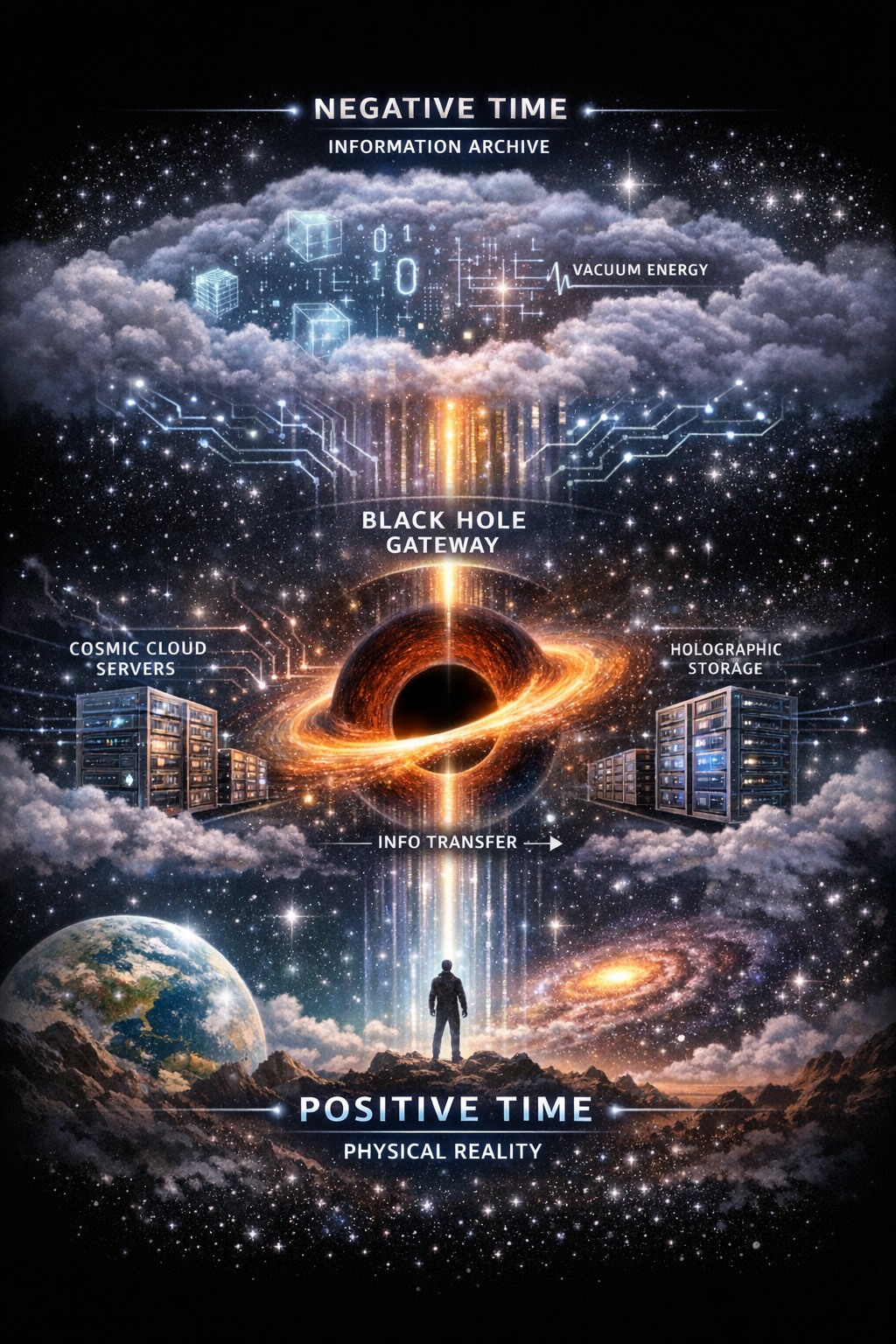
We experience life in what physicists call positive time—the forward flow of seconds, minutes, and years. It is the stage where matter moves, energy transforms, and consciousness unfolds. But what if this is only the projection layer? What if behind the screen lies a deeper system—a negative time universe, a digital archive powered by vacuum energy, where information is stored weightlessly and eternally?
In this framework, black holes are not cosmic destroyers but vaults of memory, servers of existence where the architecture of reality is preserved.
Positive vs. Negative Time
Think of time as a two‑layered system:
- Positive Time is the execution layer. It is the movie we watch, the unfolding of experience.
- Negative Time is the storage layer. It is the hard drive where every frame is archived, powered by vacuum energy.
Analogy:
- Positive time = the cinema screen.
- Negative time = the digital archive.
- Black holes = the servers.
- Vacuum energy = the electricity.
- Consciousness = the user interface.
This duality suggests that our lived reality is not the raw source but the rendered playback of deeper informational structures.
Black Holes as Digital Vaults
Physicist Jacob Bekenstein showed that black holes store information in their surface area, not their volume. The entropy of a black hole is given by:
This equation implies that black holes are information storage devices, encoding data holographically. What falls in is not destroyed—it is archived in negative time.
Example: Imagine throwing a book into a black hole. The physical book vanishes, but the information it carried—the words, the meaning—is preserved in the negative time archive. The black hole becomes a cosmic library card catalog, storing the essence of what was.
Vacuum Energy as the Power Grid
Vacuum energy is the lowest possible energy state, present even in “empty” space. Its density is expressed as:
This energy powers both layers:
- In negative time, it sustains the archive.
- In positive time, it manifests as dark energy, driving cosmic expansion.
Analogy: Just as cloud servers run continuously on electricity, the negative time archive runs eternally on vacuum energy. It is the invisible current keeping the cosmic hard drive alive.
Existence as a Signal
If negative time stores all information, then our universe is a signal replayed from this archive. Consciousness may be the interface—our memories and imagination are echoes of negative time data rendered into positive time.
Analogy:
Cultural Memory: Civilizations preserve knowledge in myths, libraries, and rituals. Negative time is the cosmic equivalent—a cultural memory of existence itself.
Cloud Computing: Just as your photos are stored in the cloud and streamed to your device, reality may be stored in negative time and streamed into positive time.
DNA Storage: DNA encodes vast amounts of information in a weightless, microscopic form. Negative time could be the DNA of the universe, encoding every possible state.
The Black Hole Information Paradox Revisited
Stephen Hawking’s paradox asked: does information vanish when matter falls into a black hole? If negative time exists, the answer is no. Information is not lost—it is transferred into the storage universe. Black holes are not graves but gateways, ensuring continuity between execution and archive.
Consciousness as the Interface
Our minds may be the readers of stored signals. Memory, imagination, and intuition could be echoes of negative time data replayed into positive time.
Example: When you recall a childhood memory, you are not just replaying neurons firing—you are tapping into the archive of negative time, where every experience is preserved. Dreams, déjà vu, and intuition may be glimpses of the archive bleeding into the execution layer.
A New Cosmological Blueprint
- Negative Time: Digital archive of all states.
- Positive Time: Projection of archived signals into experience.
- Black Holes: Gateways where information is transferred.
- Vacuum Energy: Eternal power grid sustaining both layers.
- Consciousness: The interface bridging archive and projection.
This blueprint reframes the universe as a cosmic information system, where existence is not random but structured, archived, and replayed.
Real‑World Analogies to Connect the Idea
- Cloud Computing
- Just as Google Drive or iCloud stores your files, negative time stores the universe’s data.
- Positive time is the device screen where those files are opened and experienced.
- DNA Storage
- DNA encodes billions of instructions in a molecule smaller than a grain of dust.
- Negative time could encode the entire universe in a weightless, timeless archive.
- Cultural Memory
- Civilizations preserve knowledge in myths, libraries, and rituals.
- Negative time is the cosmic equivalent—a cultural memory of existence itself.
- Suspended Animation
- In medicine and science fiction, suspended animation preserves life without aging.
- Negative time is suspended animation for information—preserving data without decay.
Why This Matters
This framework transforms black holes from mysteries into servers of existence, and vacuum energy from background hum into the power supply of reality itself. It suggests that our universe is not a fleeting accident but a signal from the past, replayed into the present by the architecture of negative time.
It also bridges science and philosophy:
- Physics explains how information is stored.
- Philosophy asks why reality is replayed.
- Consciousness experiences the signal as life.
Concluding thoughts
Positive time is the movie we watch; negative time is the hard drive storing every frame. Black holes are the ports where the movie is backed up into the archive. Vacuum energy is the electricity keeping the system alive. Consciousness is the user interface that makes it meaningful.
Our existence is not random—it is a signal from the past, replayed into the present by the architecture of negative time.
This vision invites us to see ourselves not just as participants in time, but as readers of a cosmic archive, living inside a universe that is both projection and preservation.


Leave a Reply