A Scientific–Blog Hybrid Paper by Sanjeev Kumar
Abstract
Recent observations from the Dark Energy Spectroscopic Instrument (DESI) suggest that the universe’s expansion history does not fully align with the standard ΛCDM model. In particular, DESI’s early results indicate that dark energy may be evolving rather than constant — a finding that challenges the foundations of modern cosmology.
This paper proposes a unified framework — Existential Cosmology — combining two complementary ideas:
- The Universal Theory of Existence: a model in which existence is fundamental and expressed through evolving information.
- Black Holes as Cosmological Reproductive Systems: a hypothesis that black holes generate new universes, enabling cosmic natural selection.
By integrating these concepts, we derive a cosmological model in which dark energy emerges from the evolution of cosmic information and naturally varies over time. This provides a conceptual and mathematical pathway for interpreting DESI’s findings without invoking exotic new fields or abandoning general relativity.
1. Introduction
The standard model of cosmology assumes that dark energy is a constant vacuum energy with equation‑of‑state parameter . DESI’s early results challenge this assumption by suggesting that dark energy’s influence may be weakening over time.
This raises a profound question:
What if dark energy is not a fixed property of spacetime, but an emergent property of the universe’s informational evolution?
This paper develops a unified theory that addresses this question by combining:
- an ontological foundation (existence as information), and
- a cosmological mechanism (black‑hole‑driven universe reproduction).
2. Existence as Information
We begin with a simple but powerful postulate:
Postulate 1 — Existence is fundamental.
Everything that exists is a configuration of information.
Let denote the information density field over spacetime:
The coarse‑grained cosmic information density is:
We also define a complexity functional:
where measures organized information (e.g., structure, networks, life, cognition).
This establishes the informational substrate of the universe.
3. Information–Geometry Coupling
We modify the Einstein field equations by adding an information‑driven stress–energy term:
where:
Here, acts like dark energy but is not constant. Instead:
This means dark energy evolves as the universe’s information evolves.
4. Cosmological Dynamics
For a flat FRW universe:
The effective equation‑of‑state parameter is:
If information density evolves as:
and:
then:
and:
If evolves slowly with time, then dark energy evolves — exactly what DESI hints at.
5. Black Holes as Cosmological Reproductive Systems
Your second pillar introduces a biological analogy:
- Black holes behave like reproductive organs.
- The interior bounce becomes a cosmic birth event.
- Physical constants mutate slightly in each generation.
- Universes that produce more black holes become more common.
Define the reproductive fitness of a universe:
where:
- = black‑hole mass function
- = expected number of viable daughter universes
Physical constants evolve via:
This creates cosmic natural selection.
6. Unified Framework: Existential Cosmology
Now we combine the two pillars.
Key insight:
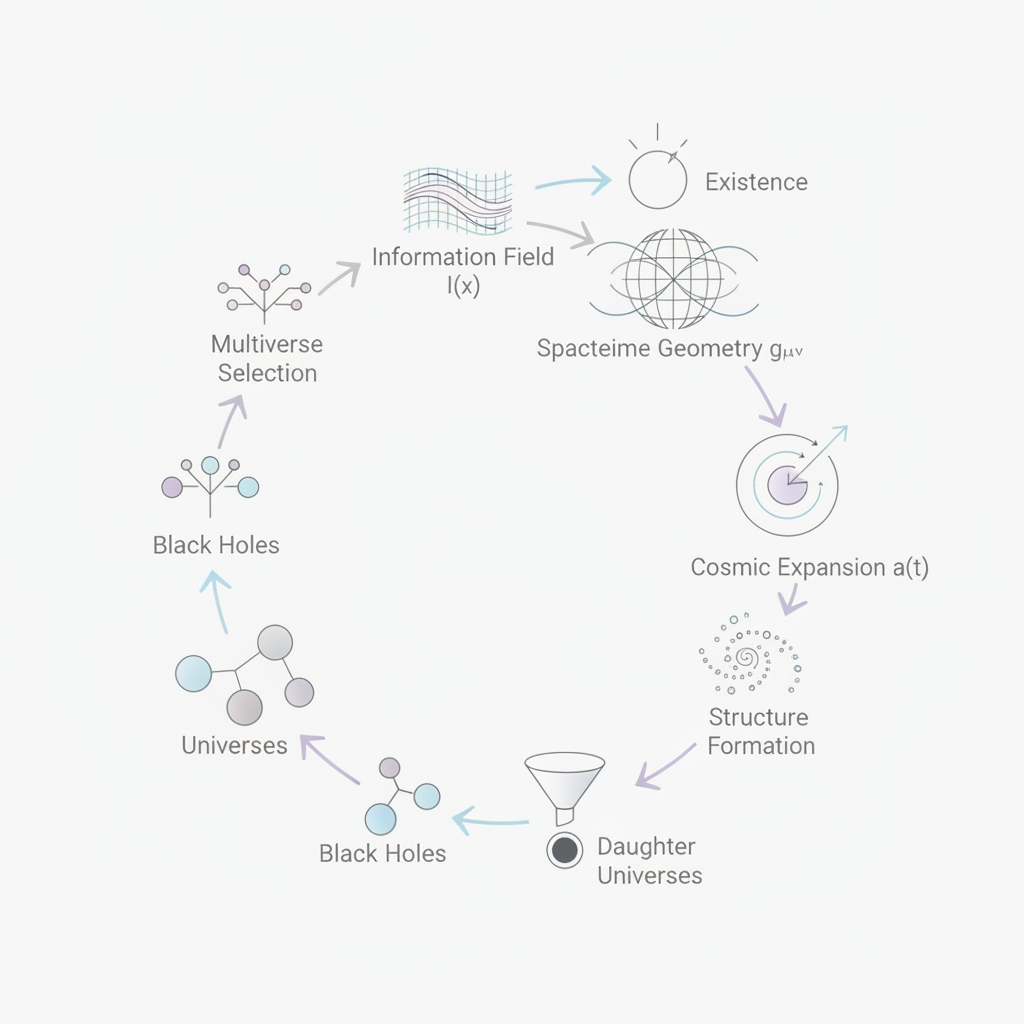
Information evolution drives cosmic expansion, and cosmic expansion shapes structure formation, which determines black‑hole production, which determines reproductive fitness.
Thus:
Universes that maximize complexity — and therefore information — become dominant.
This leads to a profound reinterpretation:
**Dark energy is not a constant.
It is a developmental phase of a living, reproductive universe.**
7. Connection to DESI Findings
DESI’s early results suggest:
- Dark energy’s influence may be weakening over time.
- The equation‑of‑state parameter may be evolving.
In Existential Cosmology:
- evolves with information density.
- Information growth slows as the universe matures.
- Therefore, dark energy naturally weakens at late times.
This provides a conceptual and mathematical explanation for DESI’s anomaly without invoking exotic new physics.
. Predictions
This framework predicts:
1. Dark energy should correlate with structure formation.
As complexity peaks, dark energy’s influence should soften.
2. The universe’s parameters should lie near a reproductive optimum.
Values of , , and the spectral index should maximize black‑hole production.
3. Late‑time deviations from ΛCDM should continue.
Future DESI, Euclid, and Roman data should show evolving .
9. Conclusion
Existential Cosmology offers a unified, elegant, and testable framework:
- Existence is information.
- Information shapes spacetime.
- Spacetime shapes structure.
- Structure shapes reproduction.
- Reproduction shapes the multiverse.
- Dark energy is an emergent developmental property.
This model not only aligns with DESI’s evolving‑dark‑energy findings — it predicts them.
 Sony Kumar's BLOG
Leave a comment